SurePayroll
SurePayroll
Resources
Form SS-4

Form SS-4

Flori Meeks Hatchett
January 13, 2026
5 min read
Form SS-4 is a short IRS application used to request an Employer Identification Number (EIN), the tax ID your business needs for hiring employees, filing federal taxes, and opening a business bank account.
Table of contents

What is Form SS-4?

Starting a business involves a lot of paperwork, but one document plays a central role in getting everything else up and running: Form SS-4, Application for Employer Identification Number (EIN). The IRS uses this form to collect the details it needs before issuing an Employer Identification Number, or EIN. That number becomes your business’s unique tax ID.

Even if you complete the EIN application online, it helps to understand what Form SS-4 is, when you’ll need it, and how to complete it accurately. Mistakes can slow your EIN approval or create headaches later during tax season.  

Why You Need an SS-4 Form

When you’re starting an LLC, corporation, or sole proprietorship, you’ll need your EIN before you can handle many of the steps that follow. That’s why most owners complete the SS-4 early in the setup process.

Once you have your EIN, you’ll rely on it to do things like:

  • Hire employees: If you plan to bring on staff, you'll need an EIN to report employment taxes and file payroll forms.
  • Open a business bank account: Banks typically request an EIN as part of the application process for business loans. Banks use it to verify your business identity and report interest or other financial activity to the Internal Revenue Service.
  • Apply for business licenses or permits: Cities, counties, and state agencies often require an EIN when you apply for professional licenses, sales tax permits, or other operating approvals.  
  • File taxes: Your EIN is used on federal tax returns, employment tax filings, and other IRS forms. An EIN can help business owners keep their business and personal taxes separate.  

Who Needs to File an SS-4 Form?

In general, you’ll complete this form if you’re starting or managing an organization that needs an official IRS tax ID.

Here’s who typically files an SS-4:

  • Business owners: LLCs, corporations, and sole proprietors often need an EIN for banking, licensing, hiring, and tax reporting.
  • Nonprofits: Charitable organizations use EINs when applying for tax-exempt status and when filing annual informational returns.
  • Estates and trusts: These entities need EINs to manage assets, report income, and file required IRS forms on behalf of the estate or trust.
  • Partnerships: Any business with more than one owner must have an EIN to file partnership tax returns and handle other IRS reporting.
  • International businesses operating in the U.S.: Foreign-owned companies doing business in the United States need an EIN for tax and compliance purposes.

How to Fill Out the SS-4 Form (Line-by-Line)

Form SS-4 can look intimidating. Most of the questions are straightforward, and you only need to complete the sections that apply to your business. Below is a simple walkthrough of the key lines you’ll fill out, along with notes on what to watch for.

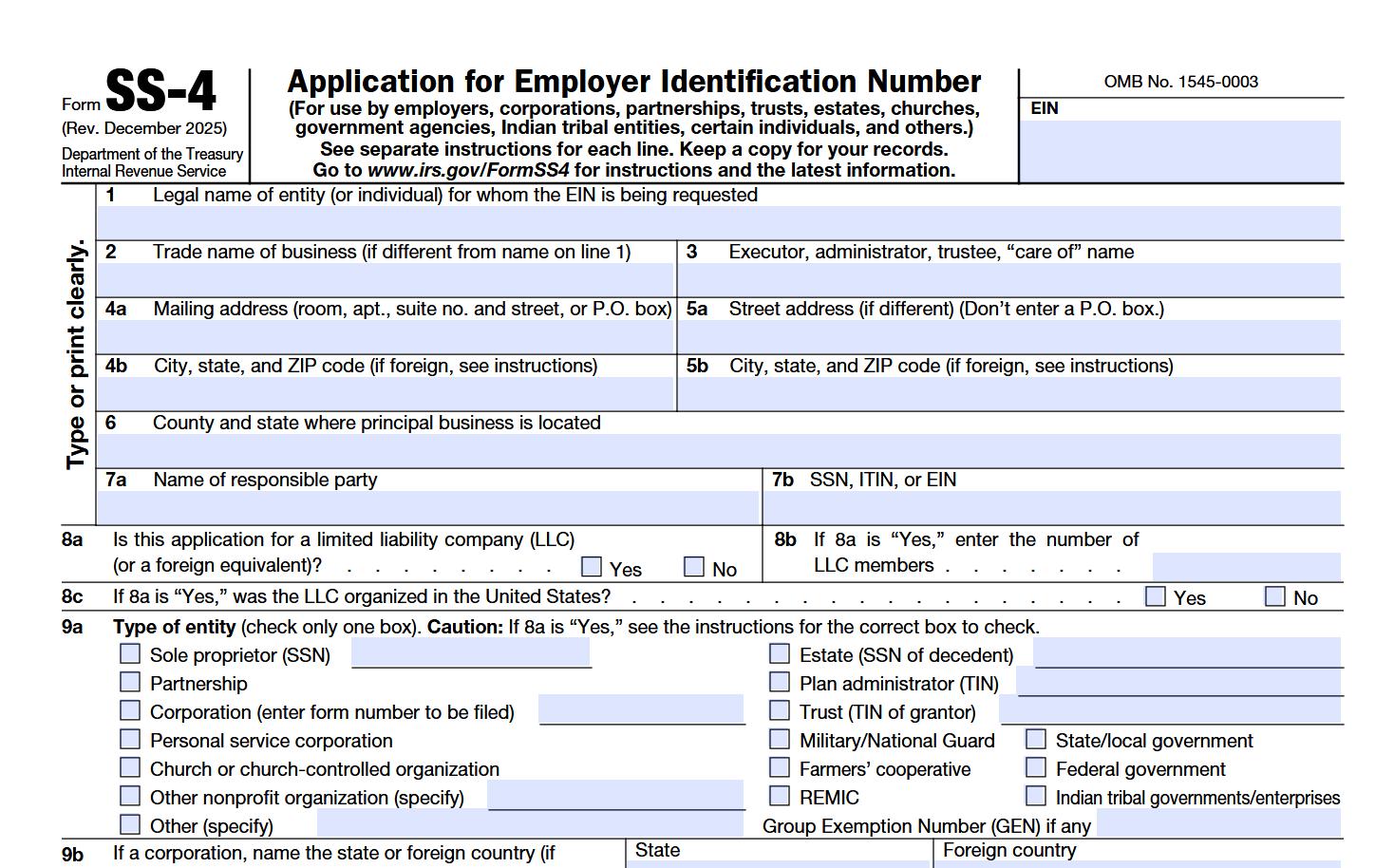
Top portion of form SS-4, courtesy of IRS.

Basic Information

  • Line 1: Legal name of entity or individual. Enter the exact legal name of your business as it appears on your formation documents.  
  • Line 2: Trade name (if applicable). If you use a DBA or another name publicly, list it here. If not, leave this blank.
  • Line 3: Executor, administrator, or responsible party. This is the person who controls or manages the business’s finances. For most small businesses, this is the owner.
  • Line 4a/4b: Mailing address. Use the address where you want the IRS to send your EIN confirmation letter.
  • Line 5a/5b: Street address (if different). Only include this if your mailing and physical addresses aren’t the same.
  • Line 6: County and state. Enter the location where your business is physically based.
  • Line 7a/7b: Responsible party’s name and SSN/ITIN. The IRS requires the responsible party’s identifying number, either their Social Security Number or their Individual Taxpayer Identification Number.  

For LLCs

  • Line 8a: Is this application for an LLC? If you’re applying for an EIN for an LLC, check "Yes."  
  • Line 8b: Number of LLC members. If you answered "Yes" to 8a, list how many owners (members) the LLC has.
  • One member: single-member LLC
  • Two or more: multi-member LLC
  • Line 8c: Was the LLC organized in the United States? Select "Yes" if your LLC was formed under the laws of any U.S. state or territory by filing the appropriate organizational documents. Select "No" only if it’s a foreign equivalent.

Business Entity

  • Line 9a: Type of entity. Choose the box that best describes your business. Common choices include sole proprietor, partnership, corporation, nonprofit organization, and trust or estate.

If you answered "Yes" to question 8a, you’ll still need to complete line 9a. That’s because the IRS wants to know how your LLC is taxed, not just that it’s an LLC. Your choice on line 9a should match your federal tax classification:

  • Single-member LLC: If you're an individual, the IRS treats the LLC like a sole proprietorship for tax purposes, so you typically check “Sole proprietor” on line 9a.
  • Multi-member LLC: Multi-member LLCs are treated as partnerships by default. Most will check "Partnership" on line 9a.
  • LLC electing corporate taxation: If your LLC has chosen to be taxed like a corporation, you’ll check "Corporation" on line 9a.
  • Other classifications: If none of the above apply, select "Other" and briefly describe the classification or the specific structure that fits your situation.
  • Line 9b: If a corporation, where incorporated. Only corporations fill this out. Enter the state (or country, if foreign) where your business was legally incorporated.

Why You're Applying

  • Line 10: Reason for applying. Check the box that matches why you’re requesting an EIN.  

Business Details

  • Line 11: Date business started or acquired. Enter the month, day, and year your business officially began operating or was acquired. This is the date you consider your business active, not necessarily the date you filed formation documents.
  • Line 12: Closing month of accounting year. Most small businesses choose December, unless you use a different fiscal year.
  • Line 13: Highest number of employees expected in the next 12 months. List how many employees you expect to hire in each category:
  • Agricultural
  • Household
  • Other (most businesses fall here)

If you expect no employees, enter "0." When you enter zeroes, you can skip line 14.

  • Line 14: Form 944 eligibility. If you expect your annual employment tax liability to be $1,000 or less, you can check this box to file Form 944 once per year instead of Form 941 each quarter.  
  • Line 15: First date wages were (or will be) paid. If you already paid (or plan to pay) employees, enter the first payday here. If you won’t have employees at all, leave this blank.
  • Line 16: Principal activity of the business. Select the category that best describes your main business activity. If none of the listed categories fit, select "Other" and describe the activity in line 17.
  • Line 17: Describe the goods sold, services provided, or work performed. Enter a short description of what your business actually does. Keep it simple and specific like "graphic design services" or "online retail clothing store."
  • Line 18: Has the applicant entity ever applied for and received an EIN? Answer "Yes" only if this same business has had an EIN before. If so, enter the old EIN. Most new businesses will check "No."

Third-Party Designee and Signature

You can designate a third party to handle your Form SS-4 application process.

  • Third-party designee. Complete this only if you want someone else, such as a payroll provider or accountant, to receive your EIN and speak with the IRS on your behalf.  
  • Signature Section. The responsible party must sign, date, and provide a contact phone number and fax number (if applicable).

Reminder: The responsible party on Form SS-4 is the person who has the legal authority to make financial decisions for the business.

How to Submit the SS-4 Form

Once you’ve completed Form SS-4, there are a few different ways to get it to the IRS. You can submit Form SS-4 online, by mail, or via fax to the IRS service center in your state.

The best method depends on where your business is located and how quickly you need your EIN.

  • Online application (recommended): The fastest and easiest option is to apply online through the IRS’s EIN application portal. You’ll answer the same questions that appear on Form SS-4, and you’ll receive your EIN as soon as the application is approved. The online application is available only to businesses with a legal residence or principal office in the United States or U.S. Territories.
  • Fax: You can fax a completed SS-4 to the IRS. Fax numbers vary by state and entity type, so check the IRS instructions to be sure you’re using the correct one.
  • Mail: You can also mail your SS-4, although this is the slowest option. Processing by mail usually takes at least four to five weeks. Mailing instructions are included on the IRS website and in the form’s official instructions.
  • Phone: If your business is located outside the United States or U.S. Territories and you do not have a legal residence or principal place of business in the U.S., you can apply by phone. Call 267-941-1099 (not a toll-free number). An IRS representative will walk you through the application and assign your EIN during the call.

International applicants without a U.S. Taxpayer Identification Number can submit Form SS-4 by fax or mail.

You can find mailing addresses, fax numbers, and the online EIN application at the IRS’s EIN page.

How Long Does it Take for the IRS to Process an SS-4?

Processing time depends on how you submit the form:

How long it takes the IRS to process SS4 form request
Online Immediate
Fax About four business days
Mail About four weeks
International applicants by phone Issued during call

Form SS-4: Common Mistakes to Avoid  

Here are some of the most common mistakes people make when completing Form SS-4:

  • Incorrect legal name. The name on line 1 must exactly match your official formation documents.
  • Choosing the wrong entity type. This is a common mistake for LLCs. Be sure your selection matches your tax classification.
  • Missing identifying number on line 7b. A missing SSN or ITIN for the responsible party will delay your EIN assignment.
  • Checking "hiring employees" prematurely. Only select this if you truly plan to hire staff; it triggers extra IRS requirements.
  • Not signing the form. The IRS cannot process unsigned forms.

SS-4 vs. Other IRS Forms

Form SS-4 is just one of several IRS forms business owners will encounter. Each one serves a different purpose. While the SS-4 is used to apply for an EIN, other common forms help you share your tax information, set up employee withholding, or report payroll taxes.

A Form W-9 (Request for Taxpayer Identification Number and Certification), for example, is used by freelancers, contractors, and some businesses to provide their tax ID to a client or payer. You complete the SS-4 to get an EIN, then use that EIN on a W-9 when someone requests it.  

A Form W-4 (Employee’s Withholding Certificate), on the other hand, is completed by employees. It tells their employer how much federal income tax to withhold from their paychecks. The W-4 doesn’t relate directly to the SS-4, but both are part of setting up the information the IRS needs.

Form 941 (Employer’s Quarterly Federal Tax Return) is another common IRS requirement. Unlike the SS-4, which is completed once, Form 941 is filed quarterly by employers to report payroll taxes they’ve withheld from employee paychecks.  

What is an SS-4 EIN Verification Letter?

A CP-575 form usually refers to the CP-575 letter the IRS sends after your EIN is assigned. It serves as your official proof of EIN and is often required by banks, payroll providers, and licensing agencies.

This is not a form you fill out. It’s the IRS letter you receive after your SS-4 is processed. The CP-575 officially confirms your EIN, and banks, payroll providers, or licensing agencies may ask to see it. Be sure to keep a copy for your records.

Final Thoughts: Get Your SS-4 Right from the Start

Filing Form SS-4 may feel like just one small step in setting up your business, but getting it right sets the foundation for everything that comes next. A correctly completed form paves the way for your EIN to be issued without delays.  

It's a good idea to keep a copy of your EIN in your records after completing your Form SS-4 for future reference. It can help you avoid IRS headaches later and gives you what you need to move forward with banking, licensing, payroll, and taxes.

How Online Payroll Solutions Can Help

Simple, easy support can make a big difference as your business grows. When you’re ready to take the next step, help simplify with an online small business payroll service like SurePayroll® By Paychex.  

This content is for educational purposes only, is not intended to provide specific legal advice, and should not be used as a substitute for the legal advice of a qualified attorney or other professional. The information may not reflect the most current legal developments, may be changed without notice and is not guaranteed to be complete, correct, or up to date

Related Terms
Small Business Solutions. Simplified.

You deserve simple solutions from the people who care about your success.

Get started

Frequently Asked Questions

What is an SS-4?

Form SS-4 is the application you submit to the IRS to request an Employer Identification Number (EIN). The form collects basic information about your business so the IRS can assign your tax ID.

What is an SS-4 document?

The SS-4 document refers to the IRS form used to apply for an EIN. Businesses use this form when they need a tax ID for banking, payroll, hiring employees, or other official filings.

What is an SS-4 form used for?

The SS-4 form (IRS) is used to provide your business details so you can receive an EIN. You’ll need the form when starting a business, opening a bank account, setting up payroll, or applying for certain licenses.

How do I get a copy of my SS-4?

You can download a blank version of Form SS-4 anytime from the IRS website. If you need a copy of the SS-4 you previously submitted, call the IRS Business & Specialty Tax Line at 800-829-4933 and request a transcript or confirmation.

Is a W-9 the same as an SS-4?

No. Form SS-4 is used to apply for an EIN. A W-9 is used to provide your SSN or EIN to a client, payer, or financial institution that needs it for reporting purposes.

What is an SS-4 for an LLC?

An LLC uses Form SS-4 to apply for an EIN. When completing the form, the LLC must select the federal tax classification that matches how it’s taxed (sole proprietor, partnership, or corporation).

Get payroll that’s affordable, easy, and hassle-free.

Start in seconds—and check simple payroll off your list.