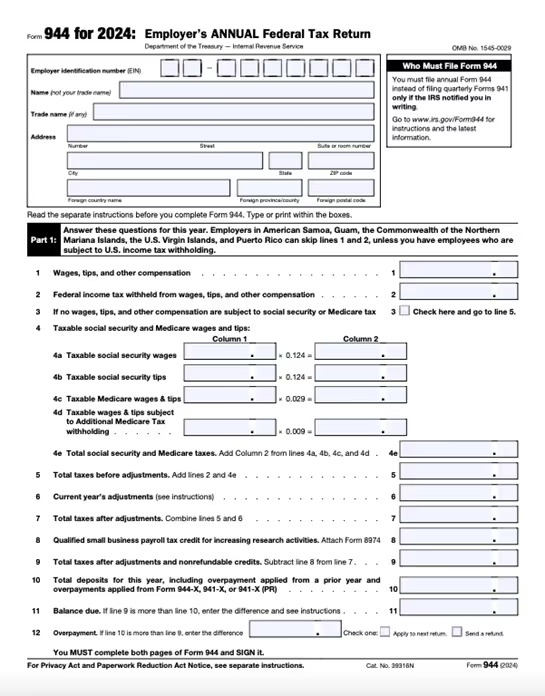
IRS Form 944 is an annual employment tax return that lets eligible small employers report federal income tax withholding, Social Security tax, and Medicare tax (FICA taxes) once a year instead of every quarter. The IRS designed Form 944 for employers whose annual employment tax liability is $1,000 or less, and only employers the IRS has notified to file it may use it.
SurePayroll® By Paychex can help eligible small employers manage payroll tax calculations, deposits, and filing requirements.
With Form 944, you’ll report information such as:
You may also be able to report certain credits or special adjustments depending on IRS rules for the year.
Form 944 is designed for employers with an annual payroll tax liability of $1,000 or less, typically the smallest of small businesses.
Only employers the IRS has notified to file Form 944 may use it. The IRS looks at whether an employer expects annual employment tax liability of $1,000 or less. You can’t choose this form on your own. To file Form 944, contact the IRS first. To return to quarterly Form 941, Employer's Quarterly Federal Tax Return, notify the IRS and receive approval before making the change.
There are also exceptions. If you employ only household workers, you generally report household employment taxes on Schedule H (Form 1040). Agricultural employers generally report taxes for farmworkers on Form 943 rather than Form 944.
The IRS usually notifies eligible businesses directly, but you can request to opt in or out if your situation changes. For instance, if your workforce grows and you owe more than $1,000 in payroll taxes, you may need to switch to filing Form 941, the Employer’s Quarterly Federal Tax Return that most employers use to report wages and payroll taxes. On the other hand, if your business shrinks or payroll remains very small, filing annually could save you time and stress. But remember, you must contact the IRS and wait for written approval before switching.
Common examples of businesses that may be required to file Form 944 include sole proprietors with one or two employees or other microbusinesses where payroll is minimal. Sole proprietors without employees (other than themselves) generally don’t need to file, since they aren’t subject to payroll taxes.
A key difference between Form 944 and Form 941 is filing frequency. Most employers file Form 941 every quarter, while an employer the IRS has notified to use Form 944 files once a year, generally because its annual employment tax liability is $1,000 or less. Both forms report federal income tax withholding, Social Security tax, and Medicare tax.
Form 941 is the quarterly federal tax return most businesses are required to file. It covers wages, employee tips, federal income tax withholdings, and both the employer and employee portions of Social Security and Medicare taxes, including any additional Medicare tax withholdings. Employers may also need to report adjustments for things like sick pay or tips. A few more considerations:
Form 944 is the once-a-year version of Form 941, available only to the smallest employers, those with $1,000 or less in total payroll taxes for the year. You can’t choose this form on your own; the IRS must notify you or approve your request.
Why does this matter? Filing once a year instead of every quarter can take a big administrative burden off a small business. But it’s important to use the right form. Filing the wrong one can cause delays, errors, or even penalties.
Here are step-by-step instructions to fill out and file Form 944. The IRS also provides detailed Form 944 instructions, and you can always download the most current version of the form directly from its website.
Before you start filling out Form 944, make sure you have the right numbers available. You’ll need details on your employees’ total wages for the year, the federal income tax you withheld from their paychecks, and the amount of payroll taxes owed. If you use payroll software or a payroll service, these figures should be easy to gather.
Completing the form:

Form 944 is an annual filing, which means you only need to submit it once a year. The Form 944 due date is January 31 of the year after the tax year. If January 31 falls on a weekend or legal holiday, the due date moves to the next business day. If you made all required deposits on time and in full, you have until February 10. For example, your 2026 form is due Monday, February 1, 2027, because January 31, 2027 is a Sunday.
Ways to file your completed Form 944:
Late filing or late payment can result in IRS penalties and interest. The penalty amount depends on how much you owe and how late the payment is. If you deposit your payroll taxes late, the failure-to-deposit penalty is 2% for deposits 1–5 days late, 5% for 6–15 days late, 10% for 16 or more days late, and 15% if the IRS has sent a notice or demand for payment and you still haven’t paid within 10 days.
If you file Form 944 late, the failure-to-file penalty is generally 5% of the unpaid tax for each month or part of a month the return is late, up to 25%. To minimize this, mark your calendar early, or work with a payroll service help you remember the due dates.
You can always check the IRS website for the latest tax due dates and filing calendar.
If the IRS requires you to file Form 944, you still need to file the required return even if you didn't report wages for the year. Report zero wages and taxes where applicable.
If you permanently went out of business or stopped paying wages, file a final Form 944 instead. Check the final-return box and enter the date you last paid wages. The IRS also requires you to attach a statement identifying who will keep your payroll records and where those records will be kept.
Here are some of the most common pitfalls and how to steer clear of them.
Calculation errors for taxes or credits, mistakes in reporting tips, or misclassifying workers (independent contractor vs. employee) can also cause problems. If you discover an error after filing, you can correct it on Form 944-X.
If you’re required to file Form 944, SurePayroll can calculate payroll taxes and manage the information needed for the annual return.
“I don’t have to worry about taxes or statements at all since everything is taken care of automatically.” — Raji, TrustPilot review
From quarterly 941s to year-end W-2s, SurePayroll supports the tax side of payroll. Free setup. No commitment required.
This content is for educational purposes only, is not intended to provide specific legal advice, and should not be used as a substitute for the legal advice of a qualified attorney or other professional. The information may not reflect the most current legal developments, may be changed without notice and is not guaranteed to be complete, correct, or up to date