-min%20(1).avif)
“I recommend SurePayroll to everybody. I tell them, ‘Just go through SurePayroll and you’ll never have to worry about anything.’”
-min.avif)
“Being able to depend on SurePayroll to run payroll and handle payroll taxes gives me tremendous peace of mind.”
-min.webp)
“SurePayroll is easy, affordable, and it saves me time and headaches. I don’t have to figure out how to do payroll and taxes because SurePayroll does it for me.”

Payroll withholding tables are the IRS's way of translating federal tax law into a repeatable, per-paycheck calculation.
For small employers, the tables connect three inputs, an employee's Form W-4 (Employee’s Withholding Certificate), pay frequency, and gross wages, to the correct federal income tax withholding amount for each paycheck.
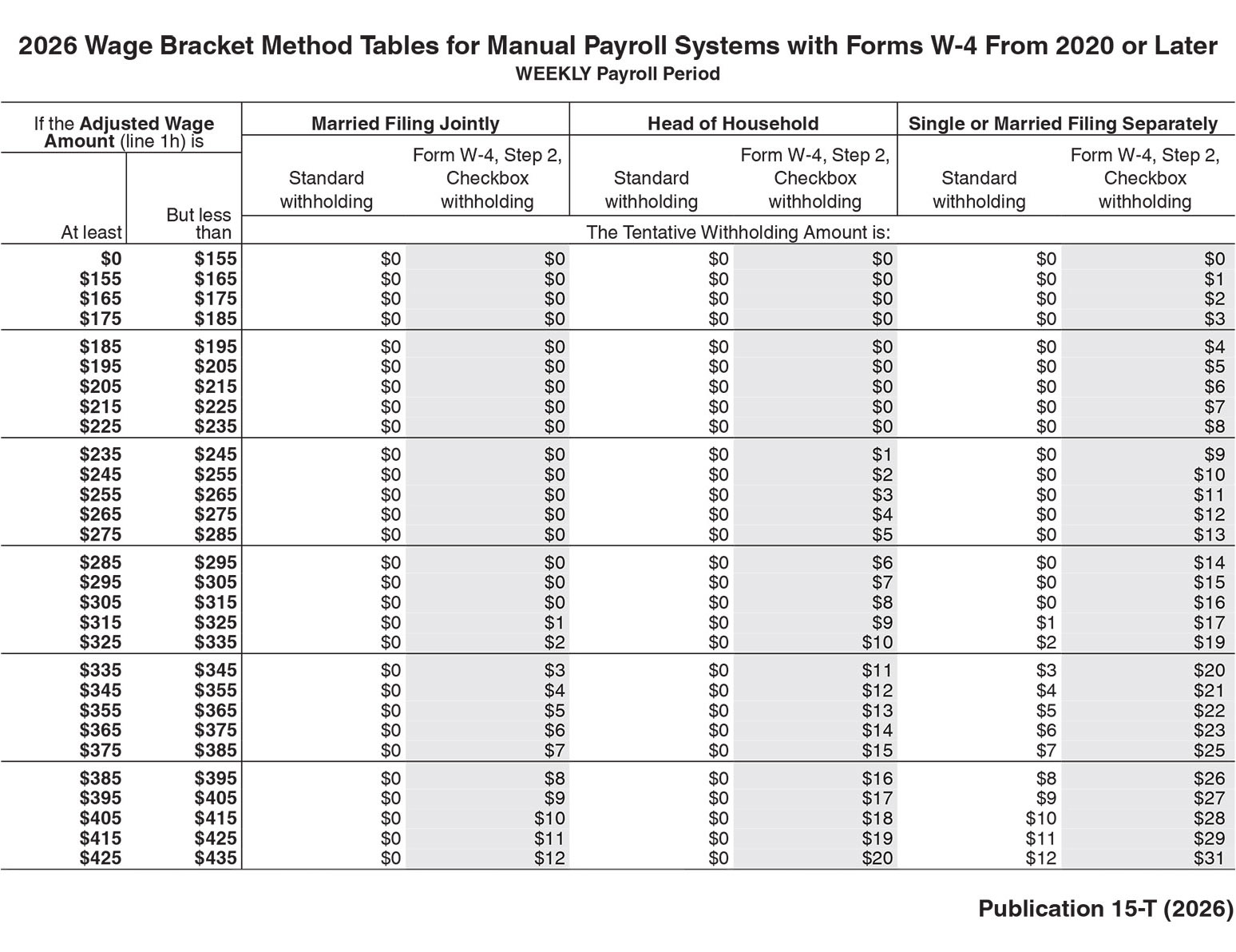
Small business owners running payroll manually reference the withholding tax tables directly in Publication 15-T, Federal Income Tax Withholding Methods, while payroll services automatically apply the same tables.
An IRS withholding table is a reference that tells employers how much federal income tax to withhold from an employee's paycheck. The IRS publishes a set of these tables each January in Publication 15-T, the IRS tax guide for income tax withholding, to reflect current tax law and inflation-adjusted thresholds.
Withholding tables translate the federal tax code into standardized, per-pay-period amounts, so employers look up the correct withholding amount instead of calculating it across multiple tax brackets for each paycheck. This keeps income tax withholding consistent across payroll runs for businesses of all sizes.
Withholding tables apply to one specific tax: federal income tax.
Other payroll taxes follow different withholding rules. Social Security and Medicare taxes, also known as FICA, use fixed statutory rates, and most states publish separate withholding tables for state income tax.
A federal withholding table lookup only addresses the federal income tax portion of each paycheck.
Each IRS withholding table lookup draws on the same three inputs: pay frequency, the employee's Form W-4, and the employee’s wages (gross wages for the pay period). Together, these inputs determine the correct income tax withholding amount for each paycheck.
Pay frequency determines which IRS withholding table applies. Publication 15-T organizes its tables by pay period: weekly, biweekly, monthly, or semimonthly payroll period. Each payroll run references the table that matches how often the business pays its employees.
An employee’s completed Form W-4 provides the tax elections you use in the withholding calculation, along with identifying information such as the employee’s Social Security identification number (SSN).
These elections (formerly called withholding allowances) include filing status (such as single, married filing jointly, married filing separately, or head of household), dependent and tax credit information, and any additional amount of tax the employee elects to withhold each pay period.
The tax information on Form W-4 determines which column to use in the withholding table.
Withholding tax tables apply to gross wages for the pay period, not annual salary or net pay, even if an employee’s annual wage is consistent throughout the calendar year. For salaried employees, gross wages stay consistent from period to period. For hourly employees, gross wages vary with hours worked, and employers calculate gross pay before referencing the table.
Any change in the employee’s wages requires a new lookup.
For a small business owner running a biweekly payroll period for three hourly employees, that's three lookups on all 26 payroll runs of the year.
Nearly 50% of small business owners report spending several hours a month on payroll tax administration, according to the National Small Business Association 2025 Small Business Taxation Survey.
Read more: DIY payroll or outsource it? Find out: Should small business owners do their own payroll.
Federal income tax applies progressive tax rates based on annual income, even though payroll operates one paycheck at a time. Withholding tables bridge that gap. They allocate estimated annual tax responsibility across individual pay periods so withholding aligns with how income tax is calculated over the full tax year for taxpayers.
As income increases, higher portions of wages fall into higher tax brackets. Filing status and other W-4 elections also affect how much tax applies. So two filers earning the same wages can have different withholding amounts. Withholding tables account for these variables in advance, so employers look up the correct withholding amount rather than calculating across multiple brackets for each paycheck.
Publication 15-T includes two methods for calculating income tax withholding: the wage bracket method and the percentage method. It also provides supporting worksheets for calculations.

The wage bracket method organizes withholding amounts by wage range and filing status, making it the standard approach for small business owners who do payroll manually. The percentage method applies a formula to adjusted wages based on applicable tax rates. Automated payroll systems use this method. The mechanics differ, but both methods rely on the same tax rules.
The IRS updates withholding tables each January to reflect inflation-related changes to tax brackets and standard deductions. These updates align withholding calculations with the current tax law.
Before processing their first payroll of the year, employers who run payroll manually must download the latest Publication 15-T to get the updated tables and worksheets to reference that calendar year.
Payroll services, such as SurePayroll® By Paychex, use the same IRS tables to automatically calculate income tax withholding for every payroll run.
Payroll automation can save business owners valuable time. More than one-third of small business owners use a payroll service provider to automate payroll calculations, according to The National Small Business Association's 2025 Small Business Taxation Survey.
Spend more building your business and less time calculating payroll taxes when you choose SurePayroll to automate payroll tax calculations, filings and deposits. See how you can put SurePayroll to work for your business.
This content is for educational purposes only, is not intended to provide specific legal advice, and should not be used as a substitute for the legal advice of a qualified attorney or other professional. The information may not reflect the most current legal developments, may be changed without notice and is not guaranteed to be complete, correct, or up to date